THE 3 TYPES OF GIRLY
THE 3 TYPES OF GIRLY
The onslaught starts the day we are born, the bombardment thrown at us by the world telling us who we are and what. Little packets of energy from individual people, or media which, of course, is created by individual people, hurled in our direction deliberately or accidentally that inform us what kind of humans women are. Blah, blah, blah, discussion about things that are biological or cliche… those conversations are for other occasions. It’s more interesting to think about who we are in ordinary life.
What would the woman in front of you think if someone stepped on to the bus wearing a banana costume? Would she laugh immediately? Maybe she’s a screenwriter who will use the image of a teenage boy in a banana costume in her script. Maybe she’s a social worker or doctor who has immediate concerns about banana-boy’s mental health. Maybe she’s a risk analyst for the city bus system and not only knows, off the top of her head, how much her employer might be liable for if banana-boy slips on his costume, but also knows who to email spinning the incident.
The world runs on different combinations and proportions of creative, analytical, and relational thinking. They are all necessary ways of looking at the world and most of us have to use them all regularly. However, we all have an operating persona that informs others what our dominant characteristics are, but, unless we are talking about Sheroes, the conversation never refers to women in terms of these characteristics, and definitely not in terms of women’s presence in the professional world. Bah! Humbug! It shall be that creativity, analytical thinking, and relational skills are equated with girliness! In light of the discrepancy between who women are and who we are supposed to be, it comes down to the question, exactly what kind of girly are you?
We can use the world of ballet and Degas’ studies of ballerinas to illustrate these three types of girliness.

Artists
First, the Artists. Are you dominated by creative impulses? Are you just starting out? Maybe you are part of the corps de ballet of a company in a cosmopolitan city and you are stretching before a performance like Degas, Ballet Scene 1907.
A little later you might be on stage in the middle of a long sequence of choreography, like Degas, Four Dancers, and you might be relieved you got enough sleep before rehearsal, because you can tell you are in sync with the other dancers. You’ve entered a competitive world, and sometimes weariness takes over you. You take comfort in a sweater that was knit for you by your mom, and during breaks, you rest in the hallway, like in Degas,

The Dance Lesson, Detail 1.
Maybe the appeal of dancing doesn’t lay in performing for you but in the process of storytelling through movement. You put in your time with the company, but realized that your passion is translating the language of movement into ideas. You became a choreographer.

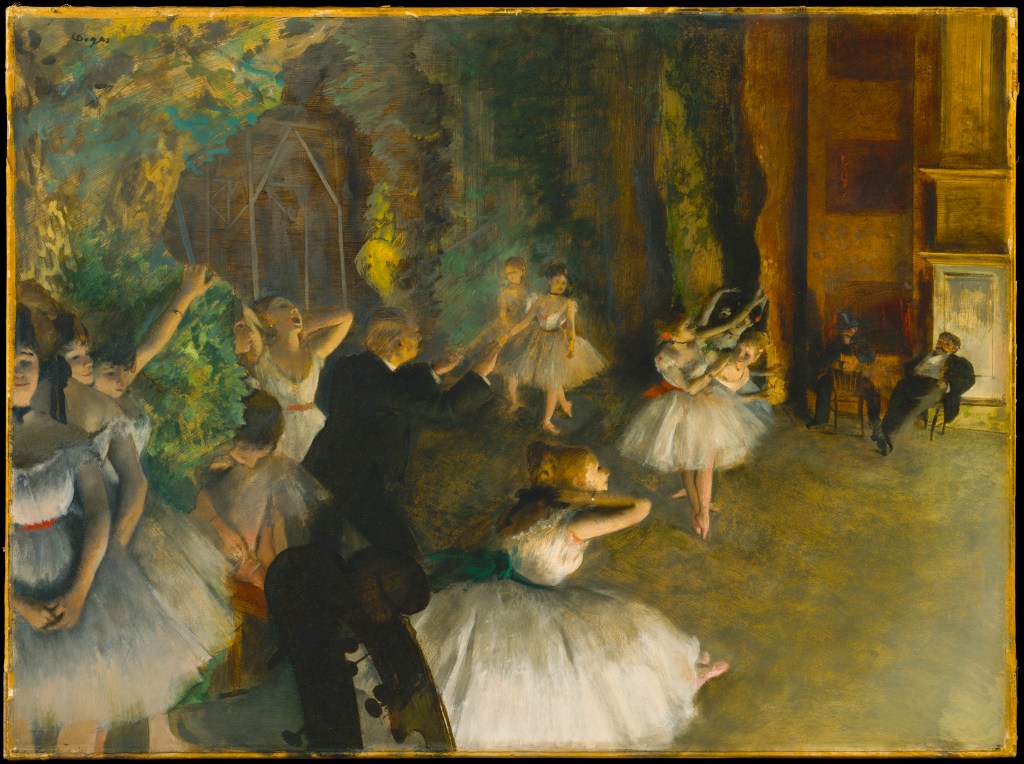
Ballet, the artistry of movement, isn’t the only art form required to complete a production. The dance also needs musicians and visual artists. Maybe you are a musician whose years of training lead you to the orchestra pit of a production 3000 miles away from your home town. Maybe you are a classical painter who helps design the sets while also running an atelier for painters. Maybe you created stage scenery trees and shrubs like in Degas, The Rehearsal of the Ballet Onstage, Detail 1.
Analysts and Technical Types
The next type of girly includes the analytical and technical types. Ballet productions need stage managers, lighting technicians, and costume designers. All three of these types concern themselves with time and timing, and there’s math involved. Stage managers collect information about the dancer, lighting and music, and set in terms of time and organize it into a master prompt script for everyone to follow during the show. Timing down to seconds matters, so if you are a stage manager, you’ve counted your way through the moments of many scenes to make sure everything runs perfectly. Stage managers also have to grease the wheels of communication among other departments, which puts them also in the category of relational folks.
Costume designers, in addition to collecting dancer measurements for perfectly fitting costumes, use their knowledge of fabric properties and history to create garments that evoke specific feelings and historical periods. Working with the choreographer to understand the overall vision of the production, and in doing so enter the realm of the creative and the relational, they design costumes that pull the audience through a story in a specific way with a particular goal.
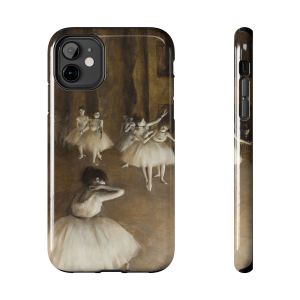
Lighting technicians are perhaps the most technical of the analytical folks in a ballet production. Maybe you took a physics class or more to understand when light waves can cancel each other out and how that relates to fixture placement. Maybe you understand how this works intuitively. Maybe you have to think of the dancers in terms of value and which one will stand out the most in terms of which lights are on her, what color her costume is, and her placement on the stage. Instead of seeing the colors and textures of the costumes produced by the costume designer, you see dancers like the Degas study Ballet Rehearsal Onstage, Detail 2.
Relational Folks
Finally, we have the folks who fill a primarily relational role in the production of the ballet – administrators and managers who make sure everyone works together, marketers who inform the world about the ballet and convince us the experience of attending it is worth our time and money, and fundraisers who make sure there is always enough money for the show to go on. Maybe you are an accountant who also fills the role of logistics expert. This is a technical role in the relational department. In particular, you keep track of expenses and schedules pertaining to the transport of costumes and sets from company workshops as well as managing finances. You liked the ballet as a child, but money was tight and all you wanted as an adult was a well-paying job, so you chose accounting. You are glad you made this decision because now all you really care about is your kid. The money for college for your teenager is almost all the way saved, which means, barring a terrible and unlikely accident, the only things you have to think about are how much you love your kid, how annoying she is, and why she and her friends have such stupid haircuts. What is it with teenagers and dumb haircuts, anyway? You know you were the same at her age but it doesn’t stop you from judging.

Outside of caring for your kid, the fact that you are near the action of a ballet company is a secondary perk after the primary perk, which is that you get to walk by the beautiful shops with the beautiful clothing made of the beautiful fabrics. Ballet costumes, like those in Degas, La Classe de Danse, represent clothing like this, but the shops you walk by carry the real thing.
These are garments that are meant to elevate existence, meant to declare that you have chosen to orient your physicality to a finer coordinate in space-time. Even if you only wear them on special occasions, your purchases from these stores are your way of celebrating being alive.
In reality, we all play all of these roles, creative, technical, and relational, but we all have dominant and supporting characteristics. How would you describe yourself? Which kind of girly are you?
References:
Bedinghaus, Treva, 12/28/18, The Hierarchy of a Ballet Company:
Titles and Positions of Members of Professional Dance Companies, https://www.liveabout.com/inside-a-ballet-company-1006747